
Why Severing a Joint Tenancy Might Protect Your Home from Care Home Fees
5 minute read

A common form of home ownership could quietly expose your entire property to care fees. Here’s how to avoid it.
Table of Contents
Introduction: The Hidden Risk for Surviving Spouses
For most couples in England and Wales, the family home is their most significant asset. It is also, in many cases, the asset most at risk if either or both require residential or nursing care in the future.
The care funding system in England and Wales is means-tested. Before a local authority contributes towards the cost of care, it carries out a financial assessment of the person’s assets and income. The family home is, in most circumstances, included in that assessment as a capital asset. If its value, combined with other assets, takes the total above the upper capital threshold (currently £23,250 in England), the individual is expected to fund their own care in full.
For couples, there is an important but frequently misunderstood protection: while one spouse or civil partner continues to live in the family home, the property is automatically disregarded in the other’s financial assessment. That protection is real, and it matters. But it is not permanent, and it does not address a bigger and more significant risk.
The risk is this. If a couple owns their home as joint tenants, and the first of them dies, the entire property passes automatically to the survivor under what is known as the right of survivorship. The survivor then owns 100% of the home. If that survivor later needs care, the entire property sits in their sole name. When they leave the property to enter care, the automatic disregard no longer applies, and the full value of the home becomes assessable.
In short, a couple who does not plan may find that the entire value of their home is exposed to the means test when the surviving partner needs care. This is not an obscure or unlikely scenario. It is one of the most common ways in which family wealth is absorbed by care costs.
The good news is that steps can be taken to address this risk. They involve understanding how property ownership works and ensuring your will is drafted to take advantage of the options available to you.
If you and your partner own your home as joint tenants and neither of you has a will that includes a protective property trust, your home may be fully exposed to care home fee assessment. Read on to find out why, and what you can do about it.
Joint Tenancy and Tenancy in Common: What Is the Difference?
Before exploring the planning options, it is important to understand the two ways in which two or more people can jointly own property in England and Wales. The distinction between them is fundamental to everything that follows.
What Is a Joint Tenancy?
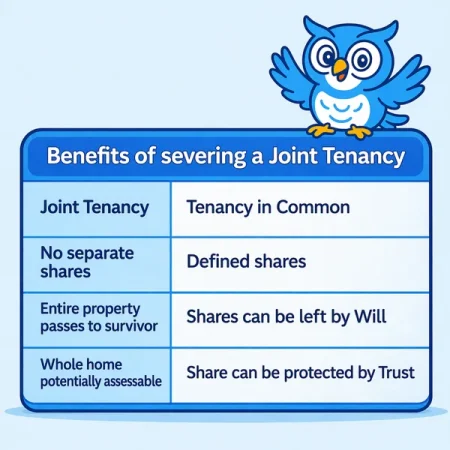
A joint tenancy is the most common form of co-ownership for married couples and civil partners. Under a joint tenancy, neither owner holds a separately defined share of the property. Instead, both owners together own the whole of it. There is no division of the property into percentages or fractions.
The defining feature of a joint tenancy is the right of survivorship. When one joint tenant dies, their interest in the property does not form part of their estate and cannot be left to anyone in their will. Instead, it passes automatically and immediately to the surviving joint tenant, regardless of what the deceased’s will says. The survivor ends up owning the entire property in their sole name.
This automatic transfer can feel like a convenience, and in many ways it is. It means there is no need for a grant of probate for the property, and the transfer occurs without any formal process. But as we have already noted, it also means that the survivor accumulates the entire value of the property in their estate, which has significant implications for care home fee planning.
What Is a Tenancy in Common?
A tenancy in common is different in one crucial respect. Under a tenancy in common, each owner holds a defined and separate share of the property. The shares do not have to be equal. A couple might hold the property in equal shares of 50% each, or in unequal shares reflecting their respective contributions to the purchase price, or in other arrangements they have agreed between themselves.
Critically, there is no right of survivorship under a tenancy in common. When one owner dies, their share does not pass automatically to the other. Instead, it forms part of their estate and passes in accordance with their will, or under the rules of intestacy if they have no will.
This is the feature that makes a tenancy in common so useful in care home fee planning. Because each owner’s share is separate and can be disposed of by will, it is possible for the first person to die to leave their share not outright to the survivor, but into a trust. That trust can then protect the deceased’s share from being included in the surviving spouse’s future care home fee assessment.
How Do You Convert from a Joint Tenancy to a Tenancy in Common?
The process of converting a joint tenancy into a tenancy in common is known as severing the joint tenancy. It is a straightforward legal process. One owner serves a written notice of severance on the other, and a restriction is then registered at HM Land Registry to record that the property is now held as tenants in common. This prevents either owner from later selling or mortgaging the property without the other’s consent or without satisfying the restriction.
Importantly, severing the joint tenancy does not require the agreement of both parties. Either owner can sever unilaterally by serving the notice on the other. In practice, however, it is almost always done by agreement as part of a wider estate planning exercise, usually in conjunction with the preparation or updating of wills.
The severance itself has no immediate effect on who lives in the property or how it is used. Day-to-day life continues exactly as before. What changes is the legal ownership structure, and the options that become available when either owner makes their will.
Can Changing Property Ownership Protect Your Home?
This is the question many people ask after reading about severing a joint tenancy, and it deserves a careful and honest answer.
Converting from a joint tenancy to a tenancy in common does not, by itself, protect your home from care home fees. The severance simply changes the legal ownership structure. What it does is open the door to a planning step that would otherwise be unavailable: the ability to leave your share of the property into a trust under your will, rather than passing it outright to your surviving spouse.
It is that trust, properly drafted and implemented at the right time, that provides the potential protection. The severance is an essential prerequisite, but it is only the first part of the process.
It is also important to be clear about what this planning can and cannot achieve. Depending on the circumstances, it may be possible to protect the deceased’s share of the property (typically 50% of the value) from being included in the surviving spouse’s future care home fee assessment. It cannot protect the survivor’s own share. And it will only be effective if the trust is set up correctly, the will is properly drafted, and the planning is put in place at the right time and for legitimate reasons.
The local authority is aware of these planning techniques and has the power, under the deprivation of assets rules in the Care Act 2014, to challenge arrangements that it concludes were made with the significant purpose of avoiding care charges. This is why professional legal advice and early planning are so important. A properly implemented plan, put in place while both parties are in good health and care is not reasonably foreseeable, is on a very different footing to an arrangement made shortly before or after a care need arises.
Life Interest Trust Wills: How They Work and Why They Matter
The legal mechanism at the heart of this planning strategy is a life-interest trust, also known as a protective property trust or property protection trust. Understanding how this trust works is essential to understanding why it can be so effective.
What Is a Life Interest Trust?
A life interest trust is a legal arrangement created within a will. When the first member of a couple dies, instead of their share of the family home passing outright to the surviving spouse, it passes into the trust. The trust then holds that share for the surviving spouse’s benefit during the surviving spouse’s lifetime. The survivor has the right to live in the property for as long as they wish. That right is secure and cannot be taken away from them. But they do not own the deceased’s share outright.
The people who will ultimately inherit the deceased’s share, typically the couple’s children or grandchildren, are known as the remainder beneficiaries. They do not receive anything while the surviving spouse is alive and occupying the property, but they have a protected interest in the trust fund that will eventually pass to them.
Why Does a Life Interest Trust Help with Care Home Fees?
The key point is this: because the deceased’s share of the property passes into a trust rather than outright to the survivor, it does not form part of the survivor’s estate. When the survivor later needs care, and the local authority carries out a financial assessment, the trust’s share of the property is not owned by the survivor and should not, in the ordinary course, be included in the assessment.
The survivor’s own share of the property will still be in their sole name and may be assessable when they leave the property and enter care. But the deceased’s share, held in trust, has a far stronger argument for being outside the scope of the means test.
In practical terms, this means that it may be possible to protect approximately half of the property’s value. For a home worth £400,000, that could mean protecting £200,000 for the next generation rather than seeing it absorbed by care costs.
Important Qualifications
A life interest trust is not a guaranteed solution, and it is important to set realistic expectations. The local authority may seek to include the trust asset in its assessment in certain circumstances, particularly if it concludes that the arrangement was made in anticipation of an imminent care need. The timing of the planning and the circumstances in which it was implemented will always be relevant.
Additionally, the trust must be properly drafted by a qualified solicitor. A poorly drafted trust, or one that gives the surviving spouse too much control over the trust fund, risks being treated as a “sham” arrangement that does not achieve the intended effect.
Example: John and Mary own their home worth £400,000 equally as tenants in common. John dies and leaves his 50% share into a life interest trust for Mary. Mary continues to live in the home. When Mary later needs care, only her 50% share (£200,000) may be assessable. John’s 50% share, held in trust, may be protected.
Mirror Wills vs Protective Property Trust Wills
Many couples who have made wills together will be familiar with the concept of mirror wills. Understanding the difference between mirror wills and protective property trust wills, and the limitations of the former, is an important part of this conversation.
What Are Mirror Wills?
Mirror wills are two wills, one for each member of a couple, that reflect each other. Typically, each person leaves everything to the other on the first death, and then to their children in equal shares on the second death. They are simple, relatively inexpensive to prepare, and by far the most common form of will made by couples.
For many couples, mirror wills are entirely appropriate. They ensure that the surviving spouse is fully provided for after the first death and that the estate eventually passes to the children without complication. In straightforward circumstances, there is nothing wrong with them.
However, mirror wills have a significant limitation in the context of care home fee planning. If each spouse leaves everything outright to the other on the first death, the survivor ends up owning the entire estate, including the entire property. That is precisely the outcome that creates the vulnerability we have been discussing.
How Protective Property Trust Wills Work Differently
A protective property trust will takes a different approach. Rather than leaving the deceased’s share of the property outright to the surviving spouse, it leaves it in a life interest trust. The survivor’s right to live in the property is preserved exactly as it would be under a mirror will, but the ownership structure is fundamentally different.
Protective property trust wills can still be drafted as a mirror pair. That is to say, each spouse can have a will that mirrors the other in all important respects, including the life-interest trust provision, so that whichever of them dies first, the plan takes effect. The Wills remain simple and straightforward from the survivor’s perspective. The key difference is the legal structure underneath.
It is important to emphasise that a protective property trust will only function as intended if the joint tenancy has first been severed. If the couple still holds the property as joint tenants at the time of the first death, the right of survivorship overrides the will entirely. The property passes automatically to the survivor regardless of what the will says, and the trust provision is rendered ineffective.
This is why the two steps, severing the joint tenancy and updating the wills, must always be done together.
What Happens to the House After the Second Death?
It is helpful to trace the practical difference between the two approaches through to their conclusion, including what happens to the property when the surviving spouse also dies.
If You Do Nothing: The Standard Mirror Will Outcome
Suppose a couple owns their home as joint tenants and each has a mirror will leaving everything to the other. The first spouse dies. The property passes automatically to the survivor under the right of survivorship. The survivor now owns the home in its entirety.
Some years later, the survivor needs residential care. They leave the property and move into a care home. The automatic disregard no longer applies because neither spouse is still living in the property. The home’s full value is included in the financial assessment. Depending on the total value of the survivor’s assets, they may be required to self-fund their care until their assets fall to the upper capital threshold. In some cases, the home may need to be sold to meet the cost.
When the survivor eventually dies, whatever remains of the estate, potentially significantly reduced by care costs, passes to the children in accordance with the will.
Using a Protective Property Trust: The Alternative Outcome
Now suppose the same couple severs the joint tenancy and updates their wills to include a protective property trust. The first spouse dies. Their 50% share of the property does not pass to the survivor outright. Instead, it passes into a life interest trust. The survivor has the right to live in the property for the rest of their life, and their quality of life and security are unaffected.
Some years later, the survivor needs care. They leave the property and move into a care home. The local authority carries out a financial assessment. The survivor owns 50% of the property in their sole name, and that share may be assessable. However, the deceased’s 50% share is held in the trust and is not owned by the survivor. It should not, in ordinary circumstances, be included in the survivor’s assessment.
When the survivor eventually dies, the trust comes to an end. The deceased’s 50% share passes to the remaining beneficiaries, typically the children, in accordance with the trust’s terms. The survivor’s own 50% share passes under their will or intestacy.
The outcome is not identical in every case, and it cannot be guaranteed. But for many families, the difference is significant, potentially preserving tens or hundreds of thousands of pounds for the next generation that would otherwise have been consumed by care costs.
Conclusion: Why Your Will Is One of the Most Important Tools in Care Planning
It would be wrong to suggest that any single legal document can fully protect your estate from care home fees. The rules are complex, they change over time, and no plan is entirely risk-free. But it would be equally wrong to conclude that nothing can be done.
A properly drafted will that incorporates a life interest trust, combined with a severance of the joint tenancy, is one of the most practical and accessible steps that a couple can take to reduce their exposure to care home costs. It preserves the surviving spouse’s right to remain in the family home. It does not disadvantage them in any practical sense during their lifetime. And it gives the family’s assets the best available chance of passing to the next generation rather than being absorbed by care fees.
The key is to act early, on proper legal advice, and while both parties are in good health. The options available to you are significantly wider when you plan ahead than when you are responding to a care need that has already arisen.
If you and your partner own your home as joint tenants and your wills leave everything outright to each other, now is a good time to review your position. A conversation with our team costs nothing and could make a very significant difference to your family’s financial future.
Find out whether a protective property trust will is right for you. Get in touch with our team for a no-obligation conversation.
Frequently Asked Questions
What is the difference between a joint tenancy and a tenancy in common?
Under a joint tenancy, two or more owners own the whole property with no defined individual shares. When one owner dies, the property passes automatically to the survivor under the right of survivorship, regardless of what the will says. Under a tenancy in common, each owner holds a defined share of the property. When one owner dies, their share passes in accordance with their will or, if they have none, under the rules of intestacy. This distinction is fundamental to care home fee planning because only a tenancy in common allows a share to be left in a protective trust.
What does severing a joint tenancy mean?
Severing a joint tenancy is the legal process of converting joint ownership of a property from a joint tenancy into a tenancy in common. One owner serves a written notice of severance on the other, and a restriction is registered at HM Land Registry. After severance, each owner holds a defined share, typically 50% each, which they can dispose of under their own will. Severing a joint tenancy is an essential first step before a protective property trust Will can be effective.
What is a protective property trust will?
A protective property trust Will, also known as a life interest trust will, is a will that leaves a person’s share of the family home into a trust on their death rather than outright to their surviving spouse. The surviving spouse retains the right to live in the property for the rest of their life, but does not own the deceased’s share outright. This means the deceased’s share may be outside the scope of a future care home fee assessment for the surviving spouse.
Can a protective property trust Will protect my home from care home fees?
A protective property trust Will can help protect the deceased’s share of the family home from being included in the surviving spouse’s care home fee means test. In practice, this could mean approximately half of the property’s value is protected. However, it cannot protect the survivor’s own share, and it is not a guaranteed solution. The effectiveness of the arrangement depends on the circumstances, including the timing of the trust’s creation and whether the local authority considers it was made in anticipation of a care need.
Do I need to sever the joint tenancy before making a protective property trust will?
Yes. If you still own your property as joint tenants when the first of you dies, the right of survivorship means the property passes automatically to the survivor, regardless of what your will says. The protective property trust provision in the will would have no effect. Severing the joint tenancy must be done before or at the same time as making the will in order for the planning to work correctly.
What is the difference between mirror wills and protective property trust wills?
Mirror wills are a pair of wills that reflect each other, typically leaving everything to the surviving spouse on the first death, and then to the children on the second death. They pass the deceased’s share of the property outright to the survivor, meaning the survivor eventually owns the entire home. Protective property trust wills also mirror each other, but instead of passing the property outright to the survivor, each will leaves the deceased’s share in a life-interest trust. This protects the share from the survivor’s future care home fee assessment while preserving the survivor’s right to live in the property.
What happens to the house when the second spouse dies if a protective property trust is used?
When the surviving spouse dies, the life-interest trust terminates. The deceased’s first spouse’s share passes to the remainder beneficiaries, typically the children, in accordance with the terms of the trust. The surviving spouse’s share passes under their will or by intestacy. The result is that the first spouse’s share is ring-fenced and passes to the next generation separately, rather than being exposed to the full force of the care home fee assessment against the survivor’s estate.
How far back can a local authority look when assessing care home fees?
There is no fixed look-back period under the Care Act 2014. A local authority can, in principle, investigate disposals of assets at any point in a person’s past if it considers that a significant purpose of the disposal was to avoid paying care charges. This is why early planning, implemented while care is not reasonably foreseeable, is so much more effective than arrangements made close to the time a care need arises.
Does converting to a tenancy in common affect day-to-day life?
No. Severing a joint tenancy and converting to a tenancy in common has no practical effect on how the couple lives in or uses the property. Both owners continue to have the same rights to occupy and enjoy the property as before. The change affects only the legal ownership structure and what happens to each person’s share upon their death. In particular, it does not affect any existing mortgage on the property, though it is good practice to notify the mortgage lender.
How much of my home could be protected by a protective property trust Will?
Where a couple holds their property equally as tenants in common, and each has a protective property trust will, the first spouse’s 50% share may be protected from the surviving spouse’s care home fee assessment. For a property worth £300,000, for example, this could mean protecting £150,000 for the next generation. The exact amount will depend on the value of the property, how the shares are held, and the outcome of any assessment by the local authority. Professional legal advice should always be taken before making any decisions.



Disclaimer
This article is intended as general information only and does not constitute legal advice. The information refers to the law of England and Wales. Tax thresholds and legal rules are correct at the time of writing but are subject to change. We recommend that you seek professional advice regarding your own circumstances.
Bio
This article was written by Stephen Rhodes. Stephen was called to the Bar of England and Wales in 1999 and brings over 25 years of in-house experience working with solicitor firms across the Manchester area, with a specialism in Wills and Probate. He now focuses exclusively on will drafting, helping his clients ensure their loved ones are taken care of exactly as they would wish.