
Lifetime Gifts and Inheritance Tax: A Complete Guide
4 minute read

Not all gifts are treated the same, and some can create unexpected tax consequences.
One of the most common questions people ask when thinking about inheritance tax planning is whether they can simply give their money or assets away during their lifetime to avoid the problem. The short answer is that you can, and that lifetime gifting is a well-established and entirely legitimate part of estate planning. But the details matter a great deal. Not all gifts are treated the same way, and some that seem straightforward can create unexpected tax complications if they are not structured correctly.
This guide explains the main categories of lifetime gifts, what each means for your inheritance tax position, and where the key pitfalls lie.
Table of Contents
Gifts That Are Immediately Exempt from Inheritance Tax
The simplest and most straightforward category of lifetime gift is one that falls entirely outside your estate from the moment it is made. These gifts do not rely on you surviving for any particular length of time, and they do not reduce your Nil Rate Band. They are exempt from inheritance tax immediately and permanently.
The Spouse and Civil Partner Exemption
You can give an unlimited amount to a spouse or civil partner who is domiciled in the United Kingdom without any inheritance tax consequences. This exemption applies both during your lifetime and on death, and it is one of the most powerful reliefs available in inheritance tax law. There is no cap on the amount, and no conditions attached beyond the requirement that your partner is UK-domiciled.
It is worth noting that this exemption does not extend to unmarried partners, regardless of how long you have been together or whether you share a home. For couples who are not married or in a civil partnership, the inheritance tax position can be considerably more exposed, and a properly drafted will becomes all the more important.
The Annual Exemption
Every individual has an annual exemption of £3,000 per tax year. Gifts up to this total value are immediately outside your estate and require no further planning or record-keeping. If you do not use your annual exemption in a given tax year, you can carry the unused portion forward to the following year, potentially allowing you to give away up to £6,000 in a single year. However, the carry-forward only works for one year: unused amounts beyond that are lost.
It is worth remembering that the £3,000 annual exemption applies to the total value of gifts made in the year, not to each individual recipient. If you give £2,000 to one child and £2,000 to another in the same tax year, only £3,000 of those gifts is covered by the exemption.
The Small Gifts Exemption
Separately from the annual exemption, you can make small outright gifts of up to £250 to any number of individuals in a tax year, and those gifts will be immediately exempt from inheritance tax. There is no limit on the number of people you can give to under this exemption. You could, for example, give £250 each to twenty different people in the same year, and none of those gifts would count towards your estate.
The one restriction is that you cannot combine the small gifts exemption with the annual exemption for the same person. If you have already given someone £3,000 under the annual exemption, you cannot also give them an additional £250 under the small gifts exemption in the same year.
Wedding and Civil Ceremony Gifts
Gifts made in consideration of a marriage or civil partnership are exempt from inheritance tax up to certain limits. The amounts vary depending on your relationship to the person getting married or entering a civil partnership. As a parent, you can give up to £5,000. As a grandparent or great-grandparent, the limit is £2,500. For any other person, the limit is £1,000.
These gifts must genuinely be made in contemplation of the marriage or civil partnership, and they must be made before the ceremony takes place. If the marriage does not go ahead, the exemption may not apply.
Gifts Out of Surplus Income
This is one of the most powerful and underused exemptions available in inheritance tax planning, but it requires careful management and proper record-keeping. Gifts made out of surplus income can be immediately exempt from inheritance tax, provided they meet three conditions. First, they must be made from income rather than capital. Second, they must be regular, forming part of a settled pattern of giving. Third, after making the gift, you must have enough income left to maintain your usual standard of living.
The key word here is surplus. You cannot simply decide to give away large sums and call them income gifts. The gifts must genuinely come from income that you do not need for your own living expenses, and there must be a regular pattern. HMRC will look at the overall picture, so maintaining clear records of your income, expenditure, and gifts is important if this exemption is to be claimed on your death.
When it works, this exemption can allow very substantial sums to be distributed from an estate over time without any inheritance tax cost. For people with significant pension income or investment income that they do not rely on for day-to-day living, it is worth taking proper advice about how to structure and document this kind of giving.
Gifts to Charities and Political Parties
Gifts made to registered UK charities or qualifying UK political parties are fully exempt from inheritance tax, whether they are made during your lifetime or on death. There is no upper limit. In addition, where more than 10% of your net estate is left to charity on death, the rate of inheritance tax on the remainder of your estate is reduced from 40% to 36%.
Understanding which exemptions apply to your circumstances can make a significant difference to your estate planning. Our specialists are happy to discuss how lifetime giving fits alongside your will. Get in touch for a no-obligation conversation.
Potentially Exempt Transfers
Beyond the immediately exempt gifts described above, a large category of lifetime gifts sits in a middle ground. These are gifts that are not taxed at the time they are made, but that are not permanently exempt either. They are known as Potentially Exempt Transfers, and the word “potentially” is important: whether they become fully exempt or not depends on how long you live after making them.
A Potentially Exempt Transfer is typically an outright gift from one individual to another. It can also include transfers into certain types of trust, such as bare trusts, though most trust transfers fall into a different category, which we discuss below.
How Potentially Exempt Transfers Work
At the time of the gift, no inheritance tax is charged. The gift leaves your estate immediately in the sense that it is no longer yours, but it remains relevant to your inheritance tax position for the next seven years. If you survive for seven years from the date of the gift, it becomes fully exempt and falls entirely outside your estate. If you die within that seven-year period, the value of the gift is brought back into the calculation of your estate and may be subject to inheritance tax.
When a failed Potentially Exempt Transfer is added back into the estate, it is treated as part of the taxable estate and may use up some or all of the Nil Rate Band (currently £325,000). If the Nil Rate Band is consumed by the failed gifts, the remaining estate is taxed at 40%. In those circumstances, the recipient of the gift may be primarily liable for the inheritance tax attributable to it, not the estate.
Taper Relief on Failed Potentially Exempt Transfers
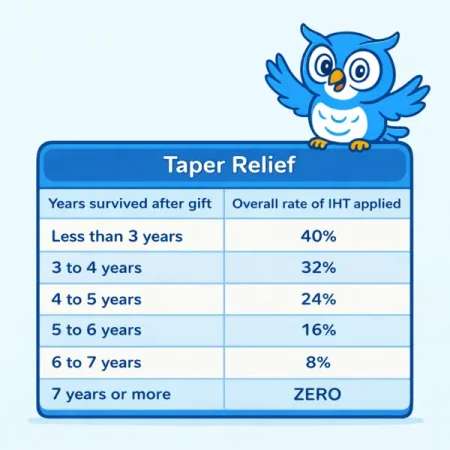
If you die between three and seven years after making a Potentially Exempt Transfer, taper relief may reduce the amount of inheritance tax due on the gift. It is important to understand that taper relief reduces the rate of tax, not the value of the gift itself. It also only applies where tax is actually due, meaning that if the failed gift falls within the remaining Nil Rate Band, taper relief is irrelevant.
The reduction in the tax rate works as follows, measured from the date of the gift to the date of death:
- Three to four years: the tax rate is reduced by 20%, from 40% to 32%
- Four to five years: the tax rate is reduced by 40%, from 40% to 24%
- Five to six years: the tax rate is reduced by 60%, from 40% to 16%
- Six to seven years: the tax rate is reduced by 80%, from 40% to 8%
Taper relief can make a meaningful difference when large gifts are made relatively close to death, but it is not a substitute for survival. The full benefit of a Potentially Exempt Transfer only comes from surviving for the full seven years.
Chargeable Lifetime Transfers
The third main category of lifetime gift is the Chargeable Lifetime Transfer. Unlike Potentially Exempt Transfers, these gifts do attract inheritance tax at the time they are made, not just if the donor dies within seven years. They most commonly arise when assets are transferred into certain types of trust, particularly discretionary trusts and relevant property trusts.
How Chargeable Lifetime Transfers Are Taxed
The Nil Rate Band (currently £325,000) applies to Chargeable Lifetime Transfers over a rolling seven-year period. Transfers within that limit are tax-free. Above the available Nil Rate Band, inheritance tax is charged at a “lifetime rate” of 20% if the donor pays the tax, or at an effective rate of 25% if the tax is paid out of the gift itself (because the gift has to be grossed up to account for the fact that the tax is reducing its value).
If the donor dies within seven years of making a Chargeable Lifetime Transfer, additional tax may become due. The transfer is reassessed at the full 40% rate, and credit is given for any lifetime tax already paid. This means the effective additional liability on death is up to a further 20% on top of the 20% already paid.
Trusts that receive assets through Chargeable Lifetime Transfers are also subject to ongoing charges. There is a ten-year anniversary charge of up to 6% of the trust’s value, and exit charges apply when assets leave the trust. These ongoing costs need to be factored into any decision about whether a trust arrangement is the right vehicle for your planning.
Gifts With Reservation of Benefit
One of the most important rules in lifetime gifting is that a gift must genuinely be a gift. If you give something away but continue to benefit from it, the gift is treated for inheritance tax purposes as if it were never made. This is known as a gift with reservation of benefit, and it is a trap that catches many people who attempt to plan their estates without proper advice.
What Counts as a Reservation of Benefit?
The most common example is giving your home to your children while continuing to live in it without paying market-rate rent. On the face of it, this appears to be a gift: you have transferred legal ownership of the property. But because you continue to live there and enjoy the use of it without paying for that use, the gift is treated as reserved. HMRC looks through the transaction and treats the property as still belonging to you for inheritance tax purposes.
The same principle applies more broadly. If you give away investments but continue to receive the income from them, or if you give away a property but retain the right to use it for holidays, these arrangements may all be treated as gifts with reservation. The key question is whether you have genuinely and unconditionally given up all benefit from the asset.
Why Gifts With Reservation Create a Worst-of-Both-Worlds Outcome
The gift-with-reservation rules can lead to particularly damaging results. The asset remains in your estate for inheritance tax because you retained a benefit from it. But the act of transferring the legal title may also have triggered a capital gains tax liability, or stamp duty land tax if it was a property. You may therefore have incurred real tax costs at the time of the transfer, while gaining none of the inheritance tax advantages you were hoping for.
In addition, the seven-year clock for Potentially Exempt Transfers does not start running while the reservation of benefit is in effect. So even if the arrangement has been in place for many years, the inheritance tax advantage may not materialise unless and until you genuinely give up all benefit.
How to Avoid the Gift With Reservation Rules
The simplest way to avoid a gift with reservation is to give up all benefit from the asset at the time of the gift. If you give your home to your children, you must move out. If you wish to continue living there, you must pay a full market rent, and that rent must genuinely be paid. A nominal or token payment will not be sufficient.
In practice, paying a market rent for your own former home can be an effective solution for some people, but it has its own implications, including the fact that the rent you pay becomes rental income in your children’s hands and may be subject to income tax. The overall position should be considered carefully before any arrangement of this kind is put in place.
Lifetime gifting can be a highly effective part of estate planning, but the rules are detailed and the consequences of getting it wrong can be significant. Our team can help you understand which approach is right for your circumstances. Get in touch today.
How Lifetime Gifts and Your Will Work Together
Lifetime gifting and will planning are not separate exercises. They are two parts of the same picture, and decisions made during your lifetime can have a significant effect on how your estate is distributed and taxed after your death.
If lifetime gifts have used up some or all of your Nil Rate Band, the tax due on your estate may be higher than it would otherwise have been. The order in which different types of gift are taken into account, and the way in which failed Potentially Exempt Transfers interact with the death estate, can affect not only the overall tax bill but also which beneficiaries bear its cost.
A will that has been drafted with your lifetime gifting in mind can manage these interactions and ensure that the tax burden falls where you intend it to, rather than producing unfair outcomes that you did not foresee. For anyone who has made or is considering making significant gifts during their lifetime, revisiting their will at the same time is not just sensible, it is important.
If you have made significant gifts in recent years, or if you are planning to do so, we can help ensure your will reflects your full estate planning position. Contact us to find out how.
Frequently Asked Questions
How much can I give away tax-free each year?
Every individual has an annual gift exemption of £3,000 per tax year, which is immediately outside their estate for inheritance tax purposes. Any unused portion of this exemption can be carried forward to the following year, allowing up to £6,000 to be given in a single year. Separately, small gifts of up to £250 can be made to any number of individuals in the same year without inheritance tax consequences.
What is a Potentially Exempt Transfer?
A Potentially Exempt Transfer is a gift from one individual to another that is not immediately subject to inheritance tax but is not permanently exempt either. If the person making the gift survives for seven years, the gift becomes fully exempt. If they die within seven years, the value of the gift is brought back into their estate and may be subject to inheritance tax.
What is the seven-year rule for gifts?
The seven-year rule means that most lifetime gifts become fully exempt from inheritance tax if the person making the gift survives for seven years from the date of the gift. If they die within that period, the gift is brought back into account for inheritance tax purposes. Taper relief may reduce the rate of tax for gifts made between three and seven years before death.
What is taper relief on gifts?
Taper relief is a reduction in the rate of inheritance tax that applies to gifts made between three and seven years before death. It reduces the tax rate rather than the gift’s value. At three to four years, the rate is reduced by 20%. At four to five years, by 40%. At five to six years, by 60%. At six to seven years, by 80%. Taper relief only applies where inheritance tax is actually due on the gift.
What is a gift with reservation of benefit?
A gift with reservation of benefit occurs when you give away an asset but continue to benefit from it, such as giving your home to your children while continuing to live there without paying market rent. In these circumstances, the asset is treated as still forming part of your estate for inheritance tax purposes, and the seven-year period does not apply. The gift must be genuine and unconditional to be effective.
Can I give my house to my children to avoid inheritance tax?
Transferring your home to your children during your lifetime can be a legitimate inheritance tax planning strategy, but it must be done correctly. If you continue to live in the property without paying a full market rent, the gift will be treated as a gift with reservation of benefit and will remain in your estate for inheritance tax. You may also trigger capital gains tax at the time of transfer. Proper advice is essential before taking this step.
What is a Chargeable Lifetime Transfer?
A Chargeable Lifetime Transfer is a gift that attracts inheritance tax at the time it is made, rather than only if the donor dies within seven years. The most common examples are transfers into discretionary trusts or relevant property trusts. The inheritance tax rate at the lifetime stage is 20% on amounts above the available Nil Rate Band. If the donor dies within seven years, additional tax may become due at the full 40% rate, with credit for any lifetime tax already paid.
Can I give money to charity to reduce inheritance tax?
Yes. Gifts to registered UK charities are fully exempt from inheritance tax, both during your lifetime and on death. In addition, where you leave more than 10% of your net estate to charity in your will, the rate of inheritance tax on the rest of your estate is reduced from 40% to 36%.
What are gifts out of surplus income?
Gifts out of surplus income are an immediately exempt category of gift that can allow substantial sums to be passed out of an estate without any inheritance tax cost. To qualify, the gifts must be made from income rather than capital, they must be regular and form part of a pattern of giving, and they must not reduce your standard of living. Proper records are important, as HMRC will review the evidence on death.
Do I need to update my will if I make large gifts?
Yes, it is strongly advisable to review your will whenever you make significant lifetime gifts. Lifetime gifts interact with your Nil Rate Band and can affect how inheritance tax is calculated on your estate. The way your will is drafted can also determine which beneficiaries bear the cost of any tax liability arising from those gifts. A will that does not account for your lifetime gifting may produce an unfair or unintended outcome.



Disclaimer
This article is intended as general information only and does not constitute legal advice. The information refers to the law of England and Wales. Tax thresholds and legal rules are correct at the time of writing but are subject to change. We recommend that you seek professional advice regarding your own circumstances.
Bio
This article was written by Stephen Rhodes. Stephen was called to the Bar of England and Wales in 1999 and brings over 25 years of in-house experience working with solicitor firms across the Manchester area, with a specialism in Wills and Probate. He now focuses exclusively on will drafting, helping his clients ensure their loved ones are taken care of exactly as they would wish.