
How Much of My Estate Will Actually Pass to Beneficiaries?
7 minute read

Taxes, costs, and liabilities can reduce an estate more than many people expect. Careful planning can make a significant difference to what your beneficiaries actually receive.
Making a will is an important step, but it is only part of the picture. Equally important is understanding how much of your estate will actually reach the people you want to benefit, and how much may be reduced along the way by debts, taxes, and the costs of administration.
For some estates, the answer is reassuringly straightforward. For others, particularly larger estates or those with complex assets, a significant portion could be consumed by inheritance tax before the beneficiaries receive a penny. The difference between an estate that has been carefully planned and one that has not can be very substantial.
This guide explains the main factors that can diminish the value of an estate, the inheritance tax rules that apply in England and Wales, the reliefs and exemptions that may reduce the tax bill, and the planning options available to you through your will and during your lifetime.
Table of Contents
What Can Reduce the Value of Your Estate Before It Reaches Your Beneficiaries?
Before thinking about tax, it is worth noting that several other factors can reduce the amount your beneficiaries ultimately receive.
Outstanding debts are the first deduction. Any money you owe at the time of your death, including mortgages, personal loans, credit card balances, and any other liabilities, must be paid from your estate before any distribution to beneficiaries can take place. In estates with significant secured or unsecured debt, this can make a meaningful dent in the net value available.
The costs of administering the estate are also payable before distribution. These include probate fees, the fees of any solicitors or accountants engaged to assist with the administration, and any costs associated with selling property or other assets. In complex estates, professional administration costs can be substantial.
Inheritance tax is then the most significant potential deduction for larger estates, and it is the focus of the rest of this guide. Unlike debts and administration costs, inheritance tax is not inevitable. With careful planning, it can often be reduced or, in some cases, eliminated.
When Does Inheritance Tax Become Payable?
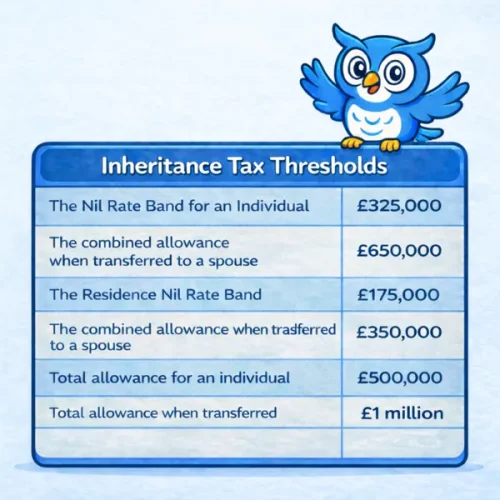
Inheritance tax in England and Wales is charged on the value of a person’s estate at the time of their death, above a threshold known as the nil rate band. The current nil rate band is £325,000. Assets below this threshold pass free of inheritance tax. Assets above it are taxed at a rate of 40%.
So, in a simple example, if your estate is worth £500,000 at the time of your death, the first £325,000 is free of tax, and the remaining £175,000 is taxed at forty per cent, producing a tax bill of £70,000.
It is important to note that the nil rate band has been frozen at £325,000 since 2009 and is currently set to remain at this level until at least 2030. As property values and other asset values have risen considerably over that period, an increasing number of estates are being drawn into the inheritance tax net that might not have been subject to tax in earlier years.
There is one very important exemption to note at this stage. Transfers between spouses and civil partners are entirely exempt from inheritance tax, regardless of value. This means that if you leave your entire estate to your spouse or civil partner, no inheritance tax is payable on your death at all. The tax liability is deferred to the death of the surviving spouse, at which point the combined estate is assessed.
The Nil Rate Band and the Transferable Nil Rate Band
As noted above, every individual has a nil rate band of £325,000. When a person leaves their entire estate to their spouse or civil partner, their nil rate band is not used up. Instead, any unused portion of the nil rate band can be transferred to the surviving spouse and added to their own nil rate band when they die.
In practice, this means that a married couple or civil partnership can effectively combine their nil rate bands, creating a potential total threshold of £650,000 on the second death before inheritance tax becomes payable.
This transferability applies automatically only when the first to die left their entire estate to their spouse. If a taxable gift was made on the first death to someone other than the spouse, the nil rate band available for transfer will be reduced proportionately.
The Residential Nil Rate Band
In addition to the standard nil rate band, there is a further allowance specifically for the family home, known as the residential nil rate band. This is currently set at £175,000 per individual and applies where a qualifying residential property interest, or assets of equivalent value where the home has been sold, is passed to direct descendants on death. Direct descendants for these purposes include children, stepchildren, adopted children, foster children, and grandchildren.
Like the standard nil rate band, the residential nil rate band is also transferable between spouses. This means that on the second death, a surviving spouse may be able to claim their deceased partner’s unused residential nil rate band in addition to their own, creating a potential combined residential nil rate band of £350,000.
When combined with the transferable standard nil rate bands, a married couple who own a qualifying residential property and leave it to their children could therefore potentially benefit from a total combined threshold of £1,000,000 before inheritance tax becomes payable on the second death.
There are, however, important limitations. The residential nil rate band tapers away for larger estates, reducing by £1 for every £2 by which the net estate exceeds £2,000,000. For very large estates, the residential nil rate band may be significantly reduced or eliminated entirely. The property must also be passed to direct descendants in the right way, and the detailed rules governing what qualifies are more nuanced than a summary can fully convey.
Could your estate benefit from the residential nil rate band? Whether and how it applies depends on the size of your estate and how your property is left. We can help you work this out.
Using Trusts for Inheritance Tax Planning
Trusts are a well-established tool in estate planning, and they can, in the right circumstances, offer useful inheritance tax advantages. However, trusts are also legally complex and carry their own tax obligations that can, if not properly managed, result in outcomes that are less tax-efficient than expected. It is important to understand both the advantages and the limitations before deciding whether a trust is appropriate for your circumstances.
The Potential Tax Advantages of a Trust
Assets placed into a trust during your lifetime may, depending on the type of trust and the circumstances, fall outside your estate for inheritance tax purposes. If you survive the gift into trust by seven years, the transfer may be free of inheritance tax altogether, subject to the rules on potentially exempt transfers, which we discuss further below. Even if you do not survive the full seven years, taper relief may reduce the tax liability.
A trust can also be used within a will to manage how assets are distributed to beneficiaries over time, rather than giving them outright. This can be particularly useful where there are minor children or vulnerable beneficiaries, or where you want to control the timing or conditions of a gift.
Life interest trusts and discretionary trusts are two of the most commonly used structures in this context. A life interest trust gives a named beneficiary the right to enjoy the income or use of an asset during their lifetime, with the capital passing to other beneficiaries on their death. A discretionary trust gives the trustees broad powers to decide how and when the trust assets are distributed among a class of potential beneficiaries.
The Tax Obligations of a Trust
Trusts are subject to their own tax regime, and the costs of that regime need to be weighed against any inheritance tax savings before deciding that a trust is the right solution.
Anniversary tax (also known as the ten-year anniversary charge or periodic charge) applies to most discretionary trusts. Every ten years after the trust is created, a charge of up to 6% is levied on the value of the trust assets above the nil rate band. This is not a catastrophic charge, but it is a real, recurring cost that accumulates over the trust’s lifetime.
Exit charges apply when assets leave a discretionary trust, for example, when a distribution is made to a beneficiary. The charge is calculated on a proportional basis, reflecting the time that has elapsed since the trust was created or since the last ten-year anniversary. Exit charges are typically modest, but they do need to be considered.
Income tax is payable by the trustees on income received by the trust, at the trust rate of 45% on most income and 39.35% on dividend income. If income is distributed to beneficiaries, they may be able to claim a credit for some of the tax already paid by the trustees, depending on their own tax position.
Capital gains tax is potentially payable when trust assets are sold or transferred. Trustees have a reduced annual capital gains tax exemption compared to individuals, and gains above the exemption are taxed at the rates applicable to trustees. Some reliefs, such as holdover relief, can defer capital gains tax when assets are transferred into or out of a trust, but professional advice is needed to ensure these reliefs are properly claimed.
Lifetime Gifts and Inheritance Tax
One of the most accessible and widely used strategies for reducing inheritance tax is making lifetime gifts. The rules governing the tax treatment of lifetime gifts are relatively straightforward in principle, though the detail warrants careful attention.
Exempt Transfers
Some lifetime gifts are entirely exempt from inheritance tax, regardless of their size or when they are made.
Gifts to spouses or civil partners are exempt without limit, just as transfers on death are exempt.
The annual exemption allows each individual to give away up to £3,000 per year free of inheritance tax. Any unused annual exemption from the previous year can also be carried forward and used, giving a potential total of £6,000 in a year where the previous year’s exemption was not used.
Small gifts exemption allows gifts of up to £250 to any number of individuals in a single tax year, as long as no other exemption has been used in respect of the same recipient.
Wedding and civil partnership gifts are exempt up to specified limits depending on the relationship between the giver and the recipient: £5,000 from a parent, £2,500 from a grandparent, and £1,000 from anyone else.
Gifts out of surplus income are a particularly valuable but underused exemption. If you can demonstrate that a gift was made out of your regular income, formed part of a habitual pattern of giving, and did not affect your standard of living, it can be entirely exempt from inheritance tax with no upper limit. This exemption requires careful record-keeping but can be very effective for those with consistent surplus income.
Gifts to charities, political parties, and certain other bodies are also fully exempt.
Potentially Exempt Transfers
Gifts made to individuals that do not fall within the exempt categories described above are known as potentially exempt transfers, or PETs. A potentially exempt transfer is a gift that will become fully exempt from inheritance tax if the donor survives for seven years after making it. If the donor dies within seven years of making the gift, the transfer is brought back into the estate for inheritance tax purposes and may be taxable.
The seven-year rule is something most people have heard of, but the precise mechanics are worth understanding.
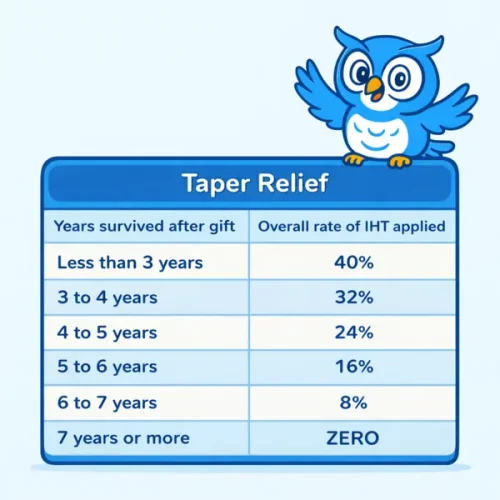
If the donor dies within three years of making the gift, the full value of the transfer is taxable at the normal inheritance tax rate of 40% (subject to any nil rate band available).
If the donor survives between three and seven years, taper relief applies. Taper relief reduces the rate of inheritance tax on the gift, not the value of the gift itself, on a sliding scale as follows.
It is also important to note that taper relief only provides a benefit where the value of the gift, combined with other gifts made in the previous seven years, exceeds the available nil rate band. If the total is below the nil rate band, no inheritance tax would have been payable on the gift in any event and taper relief is not relevant.
Keeping a clear record of all significant lifetime gifts is therefore important, both for your own planning purposes and to assist your executors when administering your estate.
Business Relief and Agricultural Relief
Two of the most significant inheritance tax reliefs available in England and Wales are Business Relief and Agricultural Relief. Both can reduce the taxable value of qualifying assets by up to 100%, potentially eliminating the inheritance tax liability on those assets entirely. However, both reliefs come with specific qualifying conditions, and the rules are changing.
Business Relief
Business Relief applies to qualifying business assets, including shares in unlisted trading companies, interests in trading partnerships, and certain business assets. Relief at 100% is available for shares in unlisted companies and for partnership interests. Relief at 50% is available for assets owned by an individual and used in their business or in a company they control, and for shares in quoted companies where the owner has a controlling interest.
To qualify, the asset must generally have been owned for at least two years before the death. The business must be a trading business, not an investment business. Investment companies and property investment businesses do not qualify, and the line between trading and investment can sometimes be a fine one in practice.
Agricultural Relief
Agricultural Relief applies to the agricultural value of qualifying agricultural property, including farmland, farm buildings, and farmhouses that are of a character appropriate to the farming operation. Relief at one hundred per cent is available where the owner farmed the land themselves or where the land is let on certain types of tenancy. Relief at 50% applies in some other letting situations.
As with Business Relief, the property must generally have been owned for a qualifying period before the death, being two years if the owner occupied the land personally and seven years if it was let to a tenant..
Anticipated Changes to These Reliefs
It is important to be aware that significant changes to both Business Relief and Agricultural Relief have been announced and are expected to take effect from April 2026, subject to final legislative confirmation.
Under the proposed changes, the combined amount of Business Relief and Agricultural Relief assets that can qualify for 100% relief will be capped at £1,000,000 per individual. Assets above that threshold would attract relief at 50 per cent rather than 100 per cent. Unused allowances will not be transferable between spouses, unlike the nil rate band.
This is a significant change for farming families and business owners with substantial assets, and it has generated considerable debate and concern. If you have farming or business assets, it is particularly important to review your estate planning in light of these anticipated changes before they take effect.
What Can Be Achieved Through Careful Will Planning?
It would be wrong to suggest that a will alone can solve every inheritance tax problem. Some planning needs to take place during your lifetime, through gifts, trusts, or asset restructuring. But a well-drafted will remains a powerful and important tool in managing how much of your estate ultimately reaches your beneficiaries, and a poorly structured Will can undo planning that has been carried out during your lifetime.
There are several specific ways in which careful will planning can reduce or mitigate the effect of inheritance tax.
Structuring the nil rate band correctly on the first death, for example, by ensuring that the first partner’s nil rate band is used rather than simply deferred, can in some circumstances produce a better overall tax outcome than leaving everything to the surviving spouse.
Using a life interest trust in the will can preserve the residential nil rate band on the first death, as we explained in our guide to the family home and inheritance tax, and can ensure that the allowances of both partners are used as efficiently as possible.
Charitable legacies in a will can reduce the inheritance tax rate applying to the remainder of the estate. If you leave at least ten per cent of the net estate to charity, the rate of inheritance tax on the taxable remainder reduces from forty per cent to 36%. For those with philanthropic intentions, this can be a tax-efficient way to support causes they care about while also reducing the overall tax burden.
Gifts made in a will to a surviving spouse or civil partner remain exempt from inheritance tax, and directing assets in this way on the first death can defer tax and allow further planning to take place during the survivor’s lifetime.
A professionally drafted Will can also include provisions that allow executors and trustees a degree of flexibility to adjust the estate’s structure after the death, for example, through a deed of variation, in order to take advantage of planning opportunities that may not have been foreseen at the time the will was made.
The key point is that inheritance tax planning and will drafting are not separate activities. They are part of a single, integrated exercise. A will that has been drafted without proper attention to the tax position of the estate may distribute assets in a way that generates an unnecessary tax bill and reduces what the beneficiaries actually receive.
We Are Here to Help
Understanding how inheritance tax works, and what can be done to reduce its impact, is one of the most valuable things you can do for the people who will inherit from you. The rules are complex, the reliefs are specific, and the planning opportunities depend heavily on the individual circumstances of each estate.
Our team has the expertise to review your estate, explain the inheritance tax position clearly, and help you structure your will in a way that makes the most of the reliefs and exemptions available to you. We will not offer you a one-size-fits-all solution. We will take the time to understand your circumstances and your wishes and provide advice that is genuinely tailored to your situation.
If you would like to discuss your estate planning, please do get in touch. You can use our online contact form or call us directly.
Frequently Asked Questions
What is the inheritance tax threshold in England and Wales?
The current nil rate band is £325,000 per individual. Assets below this threshold pass free of inheritance tax. Assets above it are taxed at 40%. Married couples and civil partners can combine their nil rate bands, creating a potential threshold of £650,000 on the second death. There is also a residential nil rate band of up to £175,000 per person when the family home is left to direct descendants.
Does inheritance tax apply when I leave everything to my spouse?
No. Transfers between spouses and civil partners are entirely exempt from inheritance tax, regardless of value. The tax liability is deferred to the death of the surviving spouse, at which point the combined estate is assessed. Any unused nil rate band from the first death can typically be transferred and used by the surviving spouse.
What is the seven-year rule for lifetime gifts?
Gifts made to individuals during your lifetime are known as potentially exempt transfers. If you survive for seven years after making the gift, it becomes fully exempt from inheritance tax. If you die within seven years, the gift may be brought back into the estate and taxed, though taper relief reduces the tax rate on gifts made between three and seven years before death.
Can I reduce inheritance tax by giving money away?
Yes, in many cases. The annual exemption allows you to give away £3,000 per year free of inheritance tax. Gifts to spouses or civil partners are fully exempt. Larger gifts to individuals are potentially exempt if you survive seven years. Gifts out of surplus income can also be exempt if the proper conditions are met and proper records are kept.
What is Business Relief, and who qualifies for it?
Business Relief can reduce the taxable value of qualifying business assets by up to 100%, potentially eliminating inheritance tax on those assets entirely. It applies to shares in unlisted trading companies, partnership interests, and certain business assets. The asset must generally have been owned for at least two years, and the business must be a trading business rather than an investment business. Significant changes to this relief are expected from April 2026.
What is the inheritance tax rate if assets are left to charity?
If you leave at least ten per cent of your net estate to charity in your will, the rate of inheritance tax on the taxable remainder of the estate reduces from forty per cent to 36%. This can be a tax-efficient way to incorporate charitable giving into your estate plan.
Related Articles



Eight Common Inheritance Tax Mistakes and How to Avoid Them
Disclaimer
This article is intended as general information only and does not constitute legal advice. The information refers to the law of England and Wales. Tax thresholds and legal rules are correct at the time of writing but are subject to change. We recommend that you seek professional advice regarding your own circumstances.
Bio
This article was written by Stephen Rhodes. Stephen was called to the Bar of England and Wales in 1999 and brings over 25 years of in-house experience working with solicitor firms across the Manchester area, with a specialism in Wills and Probate. He now focuses exclusively on will drafting, helping his clients ensure their loved ones are taken care of exactly as they would wish.