
The Complete Guide to Protecting Your Home from Care Home Fees
8 minute read

Understand the rules before they’re used against you, and discover the legal strategies families use to protect what they’ve built.
For many families in England and Wales, the family home is the most valuable asset they will ever own. It often represents a lifetime of hard work, careful saving, and the hope that something meaningful will be passed on to the next generation. That hope can feel suddenly fragile when the question of care home fees enters the picture.
The care system in England and Wales is means-tested. In simple terms, this means that if you or a loved one needs residential or nursing care, the local authority will look closely at your assets and income before it contributes a single penny towards the cost. The family home frequently falls within that assessment, and fees can run to well over £50,000 per year in many parts of the country.
This is where will-making, estate planning, and a clear understanding of the rules become genuinely important. A well-drafted will, combined with appropriate legal structures put in place at the right time, can form part of a broader strategy to protect at least a portion of your family’s wealth. It is not about avoiding obligations you legitimately owe. It is about understanding the rules clearly, planning sensibly, and acting within the law.
This guide sets out everything you need to know, from how care funding actually works to the legal steps that may help protect your estate.
Table of Contents
How Care Home Funding Works in England and Wales
The Difference Between Residential Care Homes and Nursing Homes
Not all care homes are the same, and the distinction matters when it comes to funding.
A residential care home provides accommodation, meals, and personal care support for people who need help with day-to-day living, such as washing, dressing, and managing their medication. These homes do not provide medical or nursing care as part of their standard service.
A nursing home (sometimes called a care home with nursing) provides all of the above but also employs registered nurses who are available around the clock. These homes cater for people with more complex health needs, including conditions such as advanced dementia, Parkinson’s disease, or recovery from serious illness.
The funding arrangements differ between the two, and understanding which category applies to your situation is an important first step.
Who Pays for Care?
There are three potential sources of funding for care home fees:
The individual is often the first port of call. If a person’s assets and income exceed a certain threshold (discussed below), they will be expected to pay their own fees in full. This is known as self-funding.
The local authority may contribute once a person’s assets fall below the relevant thresholds, subject to a means-tested financial assessment. Critically, the local authority will only fund care up to a standard rate for your area. If you choose a more expensive care home, a “top-up” fee will usually be required from a family member or a third party.
The NHS may fund care in certain circumstances, though the criteria for this are strict and, in practice, relatively few people qualify.
When Will the NHS Pay? NHS Continuing Healthcare
NHS Continuing Healthcare (CHC) is a package of care arranged and funded entirely by the NHS for individuals outside of hospital whose primary need for care arises from a health condition rather than a social or personal care need.
The key phrase here is “primary health need.” A multidisciplinary team assesses whether a person’s overall care needs are so complex, intense, or unpredictable that they go beyond what a local authority is expected to provide. If someone qualifies for CHC, the NHS covers the full cost of their care, regardless of their assets or income.
However, it is important to be realistic. The criteria are inconsistently applied across different NHS Integrated Care Boards across the country, meaning that someone who qualifies for CHC in one area might not receive it in another. Nationally, the proportion of care home residents who receive CHC funding is relatively small. Many families assume the NHS will eventually step in and cover costs, only to find that their relative does not meet the threshold.
If you believe a loved one may qualify for CHC, you can request a formal assessment. However, you should not rely on CHC funding as part of any long-term care planning strategy. It is available only to those with the most significant and complex health needs.
The Local Authority Means-Tested Assessment
If an individual does not qualify for NHS CHC funding, and their care needs cannot be met at home, the local authority has a legal duty to assess both their care needs and their financial position. The financial assessment is the part that causes most concern for families.
Understanding the Means Test: What the Local Authority Will Assess
The Financial Assessment
When a person enters a care home and seeks local authority support with fees, the council will carry out a financial assessment, often referred to as a financial assessment or means test. This is governed primarily by the Care Act 2014 and the associated statutory guidance (the Care and Support Statutory Guidance).
The purpose of the assessment is to determine how much the individual can reasonably contribute towards their own care costs, and how much, if any, the local authority should contribute.
Which Assets Are Taken Into Account?
The financial assessment considers the individual’s capital assets and income. Capital assets include:
- Savings and investments
- Property (including the family home in most circumstances)
- Stocks and shares
- Certain trust assets (depending on how the trust is structured)
The family home is often the most significant asset and, as we will see below, whether or not it is included in the assessment depends on the circumstances.
The Upper Capital Threshold
For the 2024 to 2025 financial year in England, the upper capital threshold is £23,250. If a person’s capital assets exceed this figure, they are expected to pay for their own care in full. They are described as a “self-funder.”
Wales operates a slightly different system, currently with an upper threshold of £50,000 following reforms to the Welsh system. If you are based in Wales, it is important to confirm the current figures with a financial adviser, as these are subject to change.
The Lower Capital Threshold
In England, the lower capital threshold is currently £14,250. Once a person’s assets fall below this level, capital is no longer taken into account at all in the assessment. At this point, if the person’s income is also insufficient to cover their care costs, the local authority will fund the full cost of care (up to its standard rate for the area).
What Happens to Those with Assets Between the Two Thresholds?
For those whose assets fall between the lower and upper thresholds, a “tariff income” system applies. For every £250 (or part thereof) of capital between the two thresholds, the person is assumed to have an additional £1 per week of income from that capital. This assumed income is then taken into account when calculating the individual’s contribution, regardless of whether the capital actually generates that level of return.
This can be a significant financial burden for those who have modest capital tied up in assets that do not produce an income.
How Income Is Assessed
In addition to capital, the local authority will assess the person’s income. This includes:
- State Pension and any private or occupational pension
- Pension Credit
- Other benefits such as Attendance Allowance (which ceases once a person moves into a care home funded by the local authority)
- Rental income from property
In most cases, the individual is allowed to retain a small personal expenses allowance from their income (currently £30.15 per week in England). Everything else is expected to be contributed towards the cost of care.
When Is the Family Home Protected?
This is one of the most frequently asked questions we encounter. The short answer is that it depends on the circumstances. There are several situations in which the family home will not be included in the means-tested financial assessment.
When the Home Is Jointly Owned
If the family home is jointly owned by two people (for example, a married couple), and one of them moves into a care home while the other continues to live in the property, the home will not be taken into account in the financial assessment of the person entering care. The local authority cannot force a sale of a property that is the primary home of the other owner.
However, the position becomes more complex if both members of a couple eventually require care. In that situation, the property may become assessable once neither owner is living in it. This is a key reason why early planning matters.
When Family Members Live in the Property
Even if the person entering care is the sole owner of the property, the local authority has the discretion (not a legal obligation) to disregard the property’s value in certain circumstances, including:
- Where the property is the sole home of a dependent relative of the person entering care who is either aged 60 or over, incapacitated, or a child under 18 for whom the person entering care is responsible.
- Where the property is the sole home of an estranged or divorced partner who has no beneficial interest in the property.
These are discretionary disregards, meaning that the local authority has the power to disregard the property but is not legally required to do so. In practice, the disregard in relation to a dependent relative aged 60 or over is the most commonly relied upon.
The Position for Married Couples
As noted above, where one spouse moves into care, the family home is automatically disregarded in the financial assessment for as long as the other spouse continues to live there. The remaining spouse is referred to as the “qualifying occupier.”
This protection is automatic and absolute while the qualifying occupier remains in the property. The local authority cannot require the property to be sold, nor can it place a charge on the property, during this period.
However, it is important to note that if the property-owning spouse dies while in care, and the property passes under their will or intestacy to their surviving spouse, who is also in care, the position could become complicated. Early planning through a carefully drafted Will can help address this risk.
Deprivation of Assets: What You Must Understand
One of the most important concepts in care home fee planning is the deprivation of assets rules. These rules are designed to prevent people from deliberately giving away or disposing of their assets in order to reduce what they would otherwise be required to contribute towards care costs.
How the Care Act 2014 Applies
The Care Act 2014 and the Care and Support Statutory Guidance give local authorities the power to treat an individual as still possessing assets that they have disposed of, if the authority concludes that a significant purpose of the disposal was to avoid paying care charges. In these circumstances, the person is treated as if they still own the asset for the purposes of the financial assessment, even though they have already given it away.
This is sometimes called “notional capital.” The authority does not actually recover the asset but instead treats it as if it were still there when calculating the person’s contribution.
How Far Back Can the Enquiry Go?
This is where many people are surprised. Unlike some other areas of law, there is no fixed time limit on how far back the local authority can look. There is no equivalent of a “clean break” after a set number of years. The local authority can, in principle, investigate disposals of assets at any point in a person’s past if it considers that deprivation of assets may have occurred.
In practice, the further back a gift or disposal took place, and the less obvious the connection to an anticipated care need, the less likely it is that the authority will seek to challenge it. But there is no guaranteed safe harbour.
What Criteria Does the Local Authority Apply?
The key question the local authority asks is whether avoiding care charges was a significant purpose of the disposal, not necessarily the only purpose. This is an important nuance. A person may have had several reasons for giving away an asset, including a genuine desire to benefit a family member. But if the local authority considers that avoiding care charges was also a significant motivating factor, it may still invoke the deprivation rules.
Relevant factors the authority will consider include:
- The timing of the disposal in relation to any care assessment or deteriorating health
- Whether the person was aware of their potential future care needs at the time
- The person’s age and health at the time of the disposal
- Whether the disposal was to a connected person (such as a child or grandchild)
Whether there was a reasonable explanation for the disposal unconnected to care
The Local Authority's Power to Recover Assets
Where deprivation of assets is established, the local authority does not simply ignore the situation. It can:
- Treat the individual as having notional capital equal to the value of the asset given away, and calculate their contribution on that basis.
- In certain circumstances, pursue a third party who benefited from the transfer under Section 70 of the Care Act 2014, which allows the authority to recover the value of assets from the person to whom they were transferred if the transfer was made with the intention of avoiding care charges and the transferee had notice of that intention.
This is a powerful set of tools. It means that a gift intended to protect assets can, in the worst case, result in both the donor being assessed as if they still owned the asset and the recipient being pursued for its value.
When Gifts Are Not Considered a Deprivation of Assets
Not every gift or disposal will be treated as a deprivation of assets. There are circumstances where the rules will not apply, and understanding these is important for any planning strategy.
The Timing of the Gift
As mentioned above, there is no fixed look-back period. However, the timing of a gift is highly relevant. If a person makes a gift at a time when they are in good health, have no reason to anticipate needing care in the foreseeable future, and have a genuine and independent reason for making the gift (such as supporting a child through university or contributing to a house purchase), it is far less likely that the local authority will characterise it as a deprivation of assets.
Whether the Donor Could Have Reasonably Expected to Need Care
This is the key test. At the time the gift was made, could the donor have reasonably foreseen that they might need future care services? If the answer is no, it becomes very difficult for the local authority to establish that the gift was motivated by the desire to avoid care charges.
For example, a gift made by a 55-year-old in good health to help a child buy a home is very unlikely to be treated as a deprivation of assets, even if that person eventually requires care many years later. By contrast, a gift made by an 80-year-old shortly after receiving a diagnosis of dementia would be scrutinised far more carefully.
The question is always one of all the circumstances at the time. This is precisely why the timing, context, and documentation of any significant gift matters greatly.
Reasonable Steps You Can Take to Protect Against These Risks
There are several legitimate and effective steps that individuals and families can take to plan ahead. None of these are guaranteed to eliminate the risk of care costs entirely, but taken together and implemented at the right time, they can make a meaningful difference.
Lasting Power of Attorney
A Lasting Power of Attorney (LPA) is not a direct protection against care home fees, but it is an essential foundation for any care planning strategy. Without an LPA in place, if a person loses mental capacity, their family may be unable to make decisions about their finances or welfare without going through the expensive and time-consuming Court of Protection process.
There are two types of LPA: one for property and financial affairs, and one for health and welfare. Both should ideally be put in place while a person has full mental capacity, and well before any deterioration in health.
Trusts and Estate Planning
Trusts are one of the most widely discussed tools in care home fee planning, and they are also one of the most misunderstood. It is true that, in the right circumstances and when implemented at the right time, certain trust structures can offer some protection for family assets. The most commonly used approach in the context of wills is the life interest trust (also called a property trust will or property protection trust), which we discuss further in the conclusion below.
However, it is essential to understand that trusts are not a magic solution. If a trust is established at a time when the person could reasonably have anticipated needing care, or if the sole or main purpose of the trust is to avoid care charges, the local authority may challenge it. Any trust arrangement should be implemented as part of a properly considered estate plan, on sound independent legal advice, and ideally well in advance of any care need arising.
Trusts should never be presented to you as a guaranteed way to remove assets from the means test. Any adviser who suggests otherwise is not giving you accurate guidance.
Insurance Products
One option that is sometimes overlooked is specialist insurance designed to help meet care costs. The most relevant product in this context is an immediate needs annuity (sometimes called a care annuity or care fees plan).
An immediate needs annuity is purchased with a lump sum at the point at which a person enters care. In return, the insurer pays a guaranteed regular income directly to the care home for the rest of the person’s life, regardless of how long they live. Because the payments go directly to a registered care provider, they are currently free of income tax. The key advantage is that the risk of outliving your assets is transferred to the insurer. The obvious disadvantage is the upfront cost, which can be substantial.
This is a regulated financial product and should only be considered following advice from a specialist care fees financial adviser who is authorised by the Financial Conduct Authority (FCA).
The Importance of Early Financial and Legal Advice
The consistent theme running through every aspect of this guide is the importance of acting early. The options available to you, and the degree of protection you can legitimately achieve, are significantly greater if you plan ahead rather than responding to a crisis.
Ideally, estate planning and care fee planning should be considered as part of the same conversation, and that conversation should take place while everyone involved is in good health and has full mental capacity. Engaging a specialist solicitor for your will-drafting and a qualified independent financial adviser for your broader care planning is a sound combination.
Common Myths and Misunderstandings
Despite the amount written about care home fees, several persistent myths continue to cause confusion and, in some cases, lead families into making decisions they come to regret. Here are three of the most common.
Myth 1: The Seven-Year Rule Protects Gifts
This is one of the most widespread misconceptions in estate and care planning. The seven-year rule is a concept from inheritance tax law. It relates to the period after which certain lifetime gifts are exempt from inheritance tax on death. It has no equivalent in the care funding rules.
As we have explained above, local authorities can look back further than seven years when investigating potential deprivation of assets. The seven-year rule will not protect a gift from scrutiny under the care funding means test.
Myth 2: Giving Away Your Home Will Always Protect It
This is both legally inaccurate and potentially harmful advice to follow. Transferring your home to your children or other relatives does not automatically remove it from the means test. If the local authority concludes that avoiding care charges was a significant purpose of the transfer, it can treat you as still owning the property.
Additionally, once you transfer your home, it belongs to the new owner. You lose all legal control over it. If the new owner divorces, becomes bankrupt, or simply decides to sell or mortgage the property, you may find yourself with no home and no legal recourse. This is a risk that should never be underestimated.
Myth 3: The NHS Will Always Pay in the End
As we explained earlier in this guide, NHS Continuing Healthcare is available only to those with a primary health need of sufficient complexity and intensity. The proportion of care home residents who qualify is small, and the criteria are applied inconsistently across the country. Families who plan on the assumption that the NHS will eventually fund care are likely to be disappointed.
Protecting Your Assets Through Your Will: The Life Interest Trust Approach
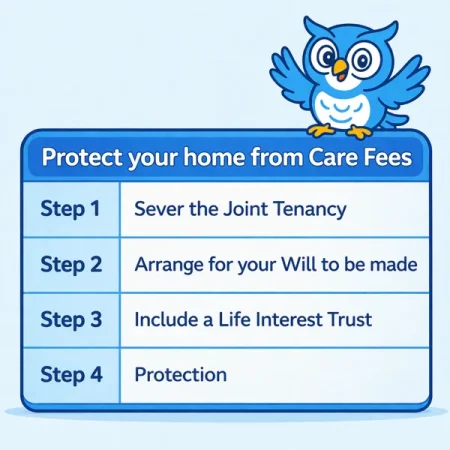
One of the most practical and widely used approaches to protecting family assets from care home fees involves a combination of two steps: severing a joint tenancy and creating a life interest trust within a will.
Severing the Joint Tenancy
Most couples who own their home together hold it as “joint tenants.” This means that on the death of one spouse or partner, the property automatically passes to the survivor regardless of what either of them says in their will. This is known as the “right of survivorship.”
While this is often convenient, it creates a vulnerability in the context of care planning. If the surviving spouse later needs care, the entire property will be in their sole name and will be assessable (subject to the disregards discussed earlier).
By severing the joint tenancy, each person instead holds a defined share of the property (typically 50% each) as “tenants in common.” Each share can then be dealt with separately under each person’s will.
Creating a Life Interest Trust in Your Will
Once the joint tenancy has been severed, each person can include a life interest trust (also called a Property Protection Trust) in their will. Under this arrangement, upon the first person’s death, their share of the property does not pass outright to the surviving spouse. Instead, it passes into a trust. The surviving spouse has the right to live in the property for the rest of their life (the “life interest”), but they do not own the deceased’s share outright.
The practical effect is that the deceased’s share of the property is held in trust and does not form part of the surviving spouse’s estate if they later need care. It may therefore be outside the scope of the means test when the surviving spouse’s care needs are assessed.
This approach cannot guarantee that 50% of the property value will be protected in every case. The local authority may seek to include the trust asset in its assessment in certain circumstances, particularly if the trust was established in anticipation of an imminent care need, or if the local authority considers the arrangement to be a deliberate deprivation. However, when implemented correctly as part of a well-considered estate plan and at a time when care was not reasonably foreseeable, this approach can offer meaningful protection for a significant portion of the family home.
It is not a step to be taken lightly or without professional legal advice. The trust must be correctly drafted and must genuinely reflect the intentions and circumstances of both parties at the time.
The Bigger Picture: Will-Drafting as Part of Your Care Planning Strategy
Care home fee planning is never a single-step process, and no single document or product will solve every problem. But a carefully drafted will is one of the most important legal tools available to you. It gives you control over how your estate is structured after your death, it can incorporate trust arrangements that offer genuine protection, and it ensures that your wishes are legally binding.
Combined with an LPA, early financial planning, and, where appropriate, specialist insurance or other products, a well-considered will forms the cornerstone of a broader strategy to protect your family’s assets.
If you are concerned about the impact of care home fees on your estate, the most important thing you can do is take advice sooner rather than later. The rules in this area are complex, they change over time, and the options available to you diminish if you wait until a care need has already arisen.
We would encourage you to get in touch with our team to discuss how we can help you put a will in place that reflects your wishes and, where appropriate, incorporates the legal structures that may help protect your family’s wealth for the next generation.
Frequently Asked Questions
Can the council take my house to pay for care home fees?
The council cannot force an immediate sale of your home while certain people continue to live there, including your spouse or civil partner, a dependent relative aged 60 or over, or a disabled or incapacitated relative. However, once the property is vacant and neither of these conditions applies, it may be included in the means-tested financial assessment. The council can also place a deferred payment agreement on the property, effectively creating a charge that is repaid when the property is eventually sold.
What is the care home fee threshold for 2024 to 2025 in England?
In England, you are expected to fund your own care in full if your capital assets exceed £23,250. If your assets fall below £14,250, capital is disregarded entirely. For those with assets between these two figures, a tariff income system applies. Note that these figures are subject to change and Wales operates under different thresholds.
Can I give my house to my children to avoid care home fees?
Transferring your home to your children does not automatically protect it from care home fees. If the local authority considers that avoiding care charges was a significant purpose of the transfer, it can treat you as still owning the property under the deprivation of assets rules. It can also, in some circumstances, pursue the recipient of the gift for the value of the asset.
What is a deprivation of assets where care home fees are concerned?
Deprivation of assets occurs when a local authority concludes that a person has disposed of assets, such as property, savings, or investments, with the significant purpose of avoiding care home charges. In these circumstances, the authority can treat the person as still owning those assets when calculating their contribution to care costs.
Does the seven-year rule apply to care home fees?
No. The seven-year rule is a concept from inheritance tax law and has no application to the care home fees means test. A local authority can investigate disposals of assets at any point in the past. There is no equivalent look-back period in the care funding rules.
Will the NHS pay for my care home fees?
The NHS will pay for care through the NHS Continuing Healthcare (CHC) scheme, but only for people whose primary need for care arises from a health condition of sufficient complexity and intensity. The criteria are strict and are applied inconsistently across different parts of the country. A relatively small proportion of care home residents qualify for CHC funding.
What is a life interest trust, and how does it protect against care home fees?
A life interest trust is a legal arrangement, usually created in a will, under which a person’s share of a property passes into a trust on their death rather than being outright transferred to a surviving spouse. The surviving spouse has the right to live in the property, but does not own the deceased’s share. This means that the deceased’s share may not form part of the surviving spouse’s assessable estate if the surviving spouse later requires care. It is most effective when the trust is created as part of a properly considered estate plan, well in advance of any care need arising.
What is the difference between a residential care home and a nursing home?
A residential care home provides accommodation, meals, and personal care for people who need help with daily living tasks. A nursing home provides the same level of support but also employs registered nurses to deliver clinical and medical care. Nursing homes are suitable for people with more complex health needs. The distinction can affect how care costs are funded, including whether the NHS contributes towards the nursing element of the fees.
What is an immediate needs annuity?
An immediate needs annuity is a financial product purchased with a lump sum at the point of entering residential or nursing care. In exchange, the insurer pays a guaranteed income directly to the care home for the rest of the person’s life. Payments made directly to a registered care provider are generally exempt from income tax. This product is regulated by the Financial Conduct Authority and should only be arranged following specialist financial advice.
Why is a Lasting Power of Attorney important in care planning?
A Lasting Power of Attorney (LPA) allows someone you trust to manage your financial affairs and, separately, to make health and welfare decisions on your behalf if you lose mental capacity. Without an LPA in place, your family would need to apply to the Court of Protection to manage your affairs, which is a costly and slow process. An LPA should be put in place while you have full mental capacity and ideally as early as possible.



Disclaimer
This article is intended as general information only and does not constitute legal advice. The information refers to the law of England and Wales. Tax thresholds and legal rules are correct at the time of writing but are subject to change. We recommend that you seek professional advice regarding your own circumstances.
Bio
This article was written by Stephen Rhodes. Stephen was called to the Bar of England and Wales in 1999 and brings over 25 years of in-house experience working with solicitor firms across the Manchester area, with a specialism in Wills and Probate. He now focuses exclusively on will drafting, helping his clients ensure their loved ones are taken care of exactly as they would wish.