
Misconceptions and Myths About Care Home Fees
4 minute read

Separating fact from fiction so you can plan with confidence.
Table of Contents
Introduction: Why So Many People Get This Wrong
Care home fees are one of the most significant financial risks that families in England and Wales face in later life, and yet they are also one of the subjects surrounded by the greatest amount of misinformation. Myths and half-truths circulate freely, often passed between family members and friends with the best of intentions. Some of these beliefs are simply outdated. Others were never true to begin with. A few contain a grain of truth that has been stretched so far out of shape that acting on them can actually make your situation worse.
The consequences of acting on bad information in this area can be severe. Families who believe that the government will automatically take the house, or that giving assets away after a certain number of years will protect them, or that the local authority will stop charging once savings run out, can find themselves either accepting a worse outcome than they need to, or taking steps that expose them to serious legal and financial risk.
This post takes some of the most common myths about care home fees and examines each of them honestly. The aim is not to alarm, but to give you an accurate picture, so that any decisions you or your family make are based on fact rather than assumption.
If you have heard any of the following beliefs from friends, family, or online, then read on. The reality in each case is more nuanced than many people realise, and understanding the facts could make a significant difference to your family’s financial future.
Myth 1: "The Government Will Take My House"
This is one of the most emotionally charged beliefs in the whole area of care home fee planning, and it is one that causes a great deal of unnecessary anxiety. The short answer is that the government, or more accurately, the local authority, does not simply take your house. The reality is more measured than that, but it does require some careful explanation.
What Can Actually Happen
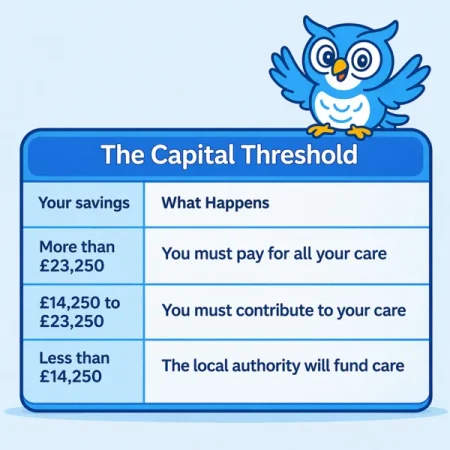
When a person moves into a care home and is assessed as having capital above the upper threshold (currently £23,250 in England), they are expected to contribute towards the cost of their own care. If the family home is their main asset and it is included in the financial assessment, the local authority may, in certain circumstances, seek to realise its value to meet the cost of care. But this does not mean it will immediately force a sale.
In many cases, the local authority will offer what is known as a deferred payment agreement. Under this arrangement, the authority pays for the care but registers a legal charge against the property. The cost of care is then repaid, with interest, when the property is eventually sold. This is typically on the death of the person in care or when they permanently leave the care home. The home is not taken in any immediate or arbitrary sense.
When the Home Is Protected
There are also important circumstances in which the family home is not included in the assessment at all. The local authority is required to disregard the value of the property while certain people continue to live in it. These include a spouse or civil partner of the person in care, a close relative aged 60 or over, or an incapacitated relative. While any of these conditions apply, the authority cannot include the property in the assessment and cannot require it to be sold.
So the picture isn’t of the government taking your house. It is, rather, one of the local authority assessing whether the value of the house should be counted when calculating how much you contribute towards care. Whether and when that assessment applies depends on your individual circumstances, and in many cases, the home is either protected or the costs are deferred.
That said, it is equally important not to be complacent. Where the home is assessable, and care costs accumulate over time, the amount owed under a deferred payment agreement can grow significantly. Planning ahead, while options are still available, is always better than dealing with the consequences of doing nothing.
Myth 2: There Is a Seven-Year Rule for Care Home Fees
Perhaps the single most persistent myth in this entire area is the belief that if you give away your assets and then survive for seven years, those assets are permanently protected from care home fees. This belief is so widespread that it warrants some detail, because it is based on a genuine legal rule that simply does not apply as people assume.
Where the Seven-Year Rule Actually Comes From
The seven-year rule is a concept from inheritance tax law. In broad terms, certain lifetime gifts are exempt from inheritance tax if the donor survives for seven years after making the gift. It is a well-established rule, and it applies in many estate planning contexts.
The problem arises when people assume that this rule also applies to the means-testing regime applied to care needs. It does not. The care home fee means test is governed entirely separately, by the Care Act 2014 and the Care and Support Statutory Guidance, neither of which contains any equivalent of the seven-year rule.
What the Care Home Fee Rules Actually Say
As we have discussed in our detailed post on the deprivation of assets rules, a local authority can investigate disposals of assets at any point in a person’s past. There is no fixed look-back period. There is no point after which a gift becomes immune from scrutiny under the care funding rules. A gift made ten or fifteen years ago could, in principle, still be challenged if the authority concludes that a significant purpose of the disposal was to avoid care charges.
In practice, the further back a gift was made and the less obvious the connection to any anticipated care need at the time, the less likely a challenge becomes. But this is a matter of judgment and probability, not a legal guarantee. Surviving seven years after a gift provides no legal protection whatsoever under the care home fee rules.
Acting on the assumption that the seven-year rule applies to care fees is one of the most common and potentially costly mistakes families make. If you have made gifts on this basis, or are considering doing so, it is important to take proper legal advice rather than relying on an assumed protection that does not exist.
The 7-year rule applies to inheritance tax, not care home fees. There is no equivalent look-back period in the care funding rules. A local authority can investigate gifts made at any point in the past.
Myth 3: You Can Legally Avoid Paying for Care
This myth takes a number of forms, but the underlying belief is the same: that with the right legal arrangement, whether it is a trust, a transfer of property, or some other mechanism, it is possible to remove all of your assets from the means test and pay nothing towards your own care.
The Grain of Truth
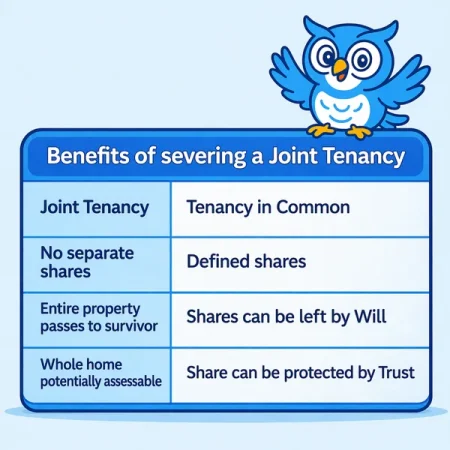
There is a grain of truth here. There are legitimate planning steps that can reduce the impact of care fees on a family’s estate. A life interest trust created through a properly drafted will, combined with severing the joint tenancy, can, in the right circumstances, protect a significant portion of a couple’s shared assets from the surviving spouse’s care fee assessment. Early and careful financial planning can help manage the risk in other ways, too. These are real and legally sound options.
The Important Distinction
The crucial distinction is between legitimate planning and deliberate avoidance. The Care Act 2014 gives local authorities the power to challenge arrangements that they conclude were made with the significant purpose of avoiding care charges. If the planning was implemented at the right time, for genuine reasons, and as part of a properly considered estate plan, it is on defensible legal ground. If it was implemented in obvious anticipation of a care need, or through a product marketed purely as a care fee avoidance tool, it is much more vulnerable.
The idea that any arrangement can simply cause all your assets to be excluded from the means test, leaving the local authority to cover the entire cost of your care regardless of your wealth, is not accurate. And those who are offered products that claim to do exactly that should approach them with considerable scepticism.
Planning within the rules, with proper legal advice and realistic expectations, is both possible and sensible. Expecting to pay nothing regardless of your financial position is unrealistic for most people, and pursuing that outcome through unsuitable or poorly constructed arrangements can create serious problems.
Myth 4: Care Fees End When Your Savings Run Out
This myth reflects a genuine misunderstanding of how the funding system transitions when a person’s capital falls below the relevant thresholds. The belief is that once your money runs out, the local authority simply takes over and pays for everything. The reality is more nuanced, and there are several important points that families often do not realise until they are already in the situation.
What Actually Happens When Capital Reduces
When a person’s assessable capital falls from above the upper threshold (£23,250 in England) towards the lower threshold (£14,250), they move through the tariff income zone, where every £250 of capital between the two thresholds is treated as generating an assumed additional £1 of income per week. This means that the contribution expected from the individual does not simply switch from full to nothing as assets reduce. It reduces gradually as capital falls through this range.
Once capital falls below the lower threshold, it is disregarded entirely. At that point, if the person’s income is also insufficient to meet the full cost of care, the local authority will fund the shortfall up to its standard rate for the area.
The Standard Rate Problem
This last point is significant and often overlooked. The local authority will fund care up to its own standard rate, but that rate may be lower than the actual cost of the care home where the person is living. If the care home charges more than the local authority rate, someone will need to make up the difference by making regular top-up payments. If no family member is willing or able to do so, the person may need to move to a different care home that the local authority will fund in full.
This can be a very difficult situation for families to navigate, particularly if the person has been living in a care home for some time and has formed important relationships and routines there.
Income Continues to Be Assessed
It is also important to understand that even where capital has been fully depleted, the local authority continues to assess the person’s income. The State Pension, any private or occupational pension, and other income sources are still taken into account. The individual retains only a small personal expenses allowance (currently £30.15 per week in England), and everything else is expected to contribute towards the cost of care. The local authority covers only what the income does not meet.
The idea that care fees simply end when savings run out is inaccurate. The assessment continues, the income contribution continues, and the local authority only funds the remaining gap. For families who have assumed the state will simply take over at some point, this can come as a significant shock.
Myth 5: Why DIY Care Fee Planning Can Backfire
In the age of the internet, it is tempting to research a topic online and conclude that you understand it well enough to take action yourself. In some areas of life, this approach works perfectly well. In care home fee planning, it can cause serious and lasting damage.
The Problem with Half-Information
The rules governing care home fees are set out in the Care Act 2014 and the associated statutory guidance, which runs to hundreds of pages. They interact with property law, trust law, tax law, and family law in ways that are not always obvious. A partial understanding of one element of the rules, without an appreciation of how it interacts with the others, can lead to decisions that appear sensible on the surface but that are legally ineffective or actively counterproductive.
For example, a person who reads that transferring their home to their children might protect it from care fees, without understanding the deprivation of assets rules, the personal risks of an outright transfer, or the alternative of a properly structured will, could act in a way that leaves them significantly worse off in terms of both care fee exposure and personal security.
The Risks of Using Unregulated Providers
There is also a significant market of companies offering care fee planning products and services that are not provided by qualified and regulated solicitors. These companies may charge substantial fees for trust products that do not achieve the protection claimed. Because they are not regulated by the Solicitors Regulation Authority, the recourse available to a family that receives poor advice is limited.
A solicitor who gives you negligent advice is subject to professional regulation, carries professional indemnity insurance, and can be held accountable. An unregulated trust company that sells you an unsuitable product may leave you with much more limited options if things go wrong.
What Proper Legal Advice Looks Like
Proper care fee planning advice begins with a full understanding of your current position, including how your property is owned, what assets you hold, what your will says, and whether you have a Lasting Power of Attorney in place. From that starting point, a solicitor can identify which options are available to you, explain the realistic benefits and limitations of each, and help you implement the ones that are appropriate, in the right order and at the right time.
It does not have to be expensive or complicated. For many couples, the most impactful steps are straightforward: severing the joint tenancy, updating their wills to include a life interest trust, and putting an LPA in place. These are not exotic legal arrangements. They are accessible, professionally drafted steps that can make a meaningful difference.
Conclusion: The Practical Steps That Can Actually Help
Having cleared away the myths, what is left is a more honest and ultimately more useful picture. Care home fees are a genuine financial risk, but they are not an unstoppable force that will inevitably consume everything your family has worked to build. There are legitimate, legally sound, and accessible steps that many families can take to reduce that risk, and the most important of those steps involves getting a properly drafted will in place.
For couples who own their home together, severing the joint tenancy and making wills that incorporate a life-interest trust is one of the most effective and defensible arrangements available. It does not involve giving assets away. It does not rely on questionable trust products. It does not need to be implemented in a hurry or in response to a crisis. And when put in place at the right time, on proper legal advice, it gives the family’s assets the best available chance of passing to the next generation.
The key, as with so much in this area, is to act early. The options available to you narrow significantly once a care need has arisen. The myths that suggest otherwise, whether it is the belief that you can always give things away later, or that the seven-year rule will protect you, or that the NHS will eventually step in, are the very beliefs that cause families to delay until delay has closed the door on the best solutions.
If you would like to understand your position clearly and take the right steps at the right time, our team would be glad to help. A straightforward conversation about your current arrangements is a good place to start.
Find out what steps are right for your situation. Get in touch with our team today.
Frequently Asked Questions
Will the government take my house to pay for care home fees?
The government does not simply take your house to pay for care. The local authority carries out a financial assessment and, if your home is included as a capital asset, may in some circumstances seek to recover care costs from its value. However, in many cases, a deferred payment agreement is offered, allowing costs to be repaid when the property is eventually sold rather than through an immediate forced sale. The home is also automatically protected from the assessment in certain circumstances, for example, while a spouse or civil partner continues to live in it.
Is there a seven-year rule for care home fees?
No. The seven-year rule is a concept from inheritance tax law and has no equivalent in the care home fee means test. A local authority can investigate disposals of assets at any point in a person’s past under the deprivation of assets rules. There is no fixed look-back period. A gift does not become immune from care fee scrutiny simply because it was made more than seven years ago.
Does the seven-year rule protect gifts from care home fees?
No. This is one of the most common misconceptions in care home fee planning. The seven-year rule applies only to inheritance tax, not to the care home fee means test. Local authorities can challenge disposals of assets regardless of how long ago they were made, if they conclude that a significant purpose of the disposal was to avoid care charges. There is no equivalent of the seven-year rule in the Care Act 2014 or the associated statutory guidance.
Can you legally avoid paying care home fees in England?
It is not generally possible to avoid care home fees entirely, but there are legitimate planning steps that can reduce their impact on a family’s estate. A life interest trust created through a properly drafted will, combined with severing the joint tenancy, can, in the right circumstances, protect a significant portion of a couple’s shared assets. However, arrangements made with the deliberate purpose of avoiding care charges are subject to challenge under the deprivation of assets rules, and any planning should be carefully implemented at the right time and with proper advice.
Do care home fees stop when your savings run out?
No. When a person’s capital falls below the upper threshold, the local authority begins to contribute towards the cost of care, but the person’s income continues to be assessed and is expected to contribute. The local authority covers the gap between the person’s assessed income contribution and the cost of care, up to its standard rate for the area. If the actual care home costs more than that rate, a top-up payment may be needed. Care fees do not simply end when savings run out.
What happens to care funding when your savings fall below £23,250?
Once your capital falls below the upper threshold of £23,250 in England, the local authority begins to contribute towards your care costs. For capital between £23,250 and the lower threshold of £14,250, a tariff income system applies, treating each £250 of capital as generating £1 of assumed income per week. Once capital falls below £14,250, it is disregarded entirely and the authority funds the gap between your income contribution and the cost of care, up to its standard rate.
Why is DIY care home fee planning risky?
The rules governing care home fees are complex and interact with property law, trust law, and tax law in ways that are not always obvious. Acting on a partial understanding of the rules can lead to decisions that are legally ineffective, counterproductive, or that expose the family to unnecessary risk. An experienced advisor can assess your full position, explain the realistic options available, and help you implement appropriate steps in the right order and at the right time.
Can transferring your home to your children protect it from care fees?
Not reliably. Transferring your home to your children does not automatically remove it from the care home fee means test. The local authority can apply the deprivation of assets rules and treat you as still owning the property if it concludes that a significant purpose of the transfer was to avoid care charges. An outright transfer also carries significant personal risks, including exposure to a child’s divorce, bankruptcy, or death. A more structured approach using a life interest trust within a properly drafted will is generally considered a safer and more effective alternative.
What is the most effective way to protect your home from care home fees?
For couples who own their home together, the most widely used and legally defensible approach is to sever the joint tenancy so that each person holds a defined share, and then to make wills that incorporate a life-interest trust. When the first person dies, their share passes into the trust rather than outright to the surviving spouse. The survivor retains the right to live in the property, but the deceased’s share may be outside the scope of the survivor’s care home fee assessment. This approach is most effective when put in place early, while both parties are in good health.
Is it worth making a will to protect against care home fees?
Yes, for many couples, a properly drafted will is one of the most important and accessible steps available. A will that incorporates a life interest trust, combined with severing the joint tenancy, can protect a significant portion of the family home from care home fee assessment. It does not involve giving assets away, does not disadvantage the surviving spouse, and, when implemented at the right time, stands on solid legal ground. It should be considered as part of a broader review of your estate planning arrangements.



Disclaimer
This article is intended as general information only and does not constitute legal advice. The information refers to the law of England and Wales. Tax thresholds and legal rules are correct at the time of writing but are subject to change. We recommend that you seek professional advice regarding your own circumstances.
Bio
This article was written by Stephen Rhodes. Stephen was called to the Bar of England and Wales in 1999 and brings over 25 years of in-house experience working with solicitor firms across the Manchester area, with a specialism in Wills and Probate. He now focuses exclusively on will drafting, helping his clients ensure their loved ones are taken care of exactly as they would wish.